
Drawing the street above eye level
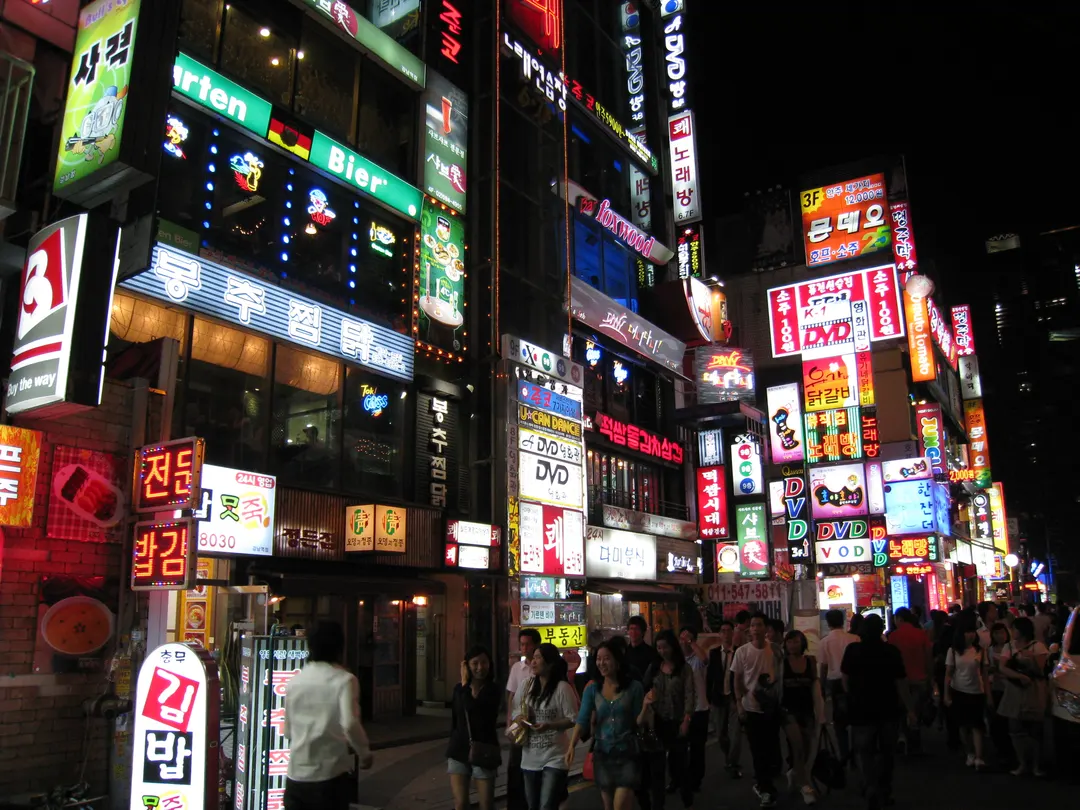

Cover the right half of the photograph with your hand. On the left, you can still make out a building: a dark upright, a band of windows, the pale strip of a sign across a floor. Take your hand away and look down the street. In the distance the signs almost touch. You can follow the street deep into the picture without seeing much pavement at all.
Save the white of the paper
Try the scene in a rectangle no larger than a postcard. Pencil in the green sign near the top left, the tall white sign at the far left edge and the bright cluster halfway down the street. Leave all three shapes empty. Shade the windows around them with the side of your pencil. The signs begin to glow long before you put a single letter on them.
Now look at the people along the lower edge. A shoulder cuts across a lit doorway; a head takes a small bite out of a pale sign. Put two or three of those interruptions into the drawing. They give the buildings a scale. If every shopfront runs cleanly to the bottom of the page, the result can look uncannily like a shelf of boxes.
Carry one colour indoors
For a second drawing, turn to the room photographs in this Korean-language guide to karaoke in Gangnam. Choose a corner where a lamp catches two surfaces. Draw the pool of light on the tabletop and the narrower glint on its edge. Leave the lamp itself until last. A small change in the shape of that reflection can tell you whether an edge is rounded or square.
Lay the two sketches side by side. On the street page, see how far your eye travels before it meets bare paper. On the room page, find the first place it comes to rest. Mark each spot with a dot on a scrap of tracing paper. Those two dots make a better note for the next evening's walk than a list of colours to buy.